
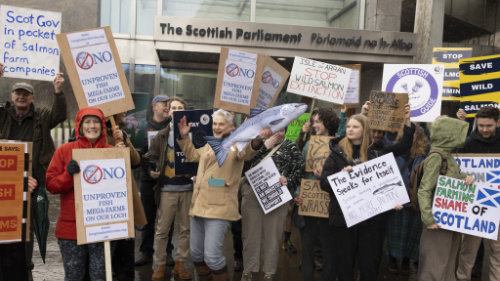
Holyrood Protest against the Expansion of Scotland's Fish Farms
Long Live Loch Linnhe joins protest at Holyrood
Dear Friends and Supporters,
First of all, a big "hats off" and huge THANK YOU's to Nick at WildFish for initiating and organising such a positive event, and to our group of seven, some of whom set off at an insanely early hour to join an impressive gathering of protesters outside Holyrood last week. There were about 100 of us, representing community groups, welfare charities, ghillies and fishermen from around Scotland - all voicing a wide range of concerns about Scotland's fish farm industry, its impacts on the environment and the demise of our iconic Wild Atlantic Salmon.
We then (literally) packed the public gallery of the Rural Affairs and Islands Committee to witness their "scrutiny" of the industry, in which committee members questioned the Cabinet Secretary and Minister for Rural Affairs and Islands, Mairi Gougeon, about some of the serious issues originally outlined in the Griggs Report commissioned in 2018. Some of these issues had already been outlined and discussed in February's committee meeting, when, in particular, Dr Alan Wells, of Fisheries Management Scotland had expressed his deep concerns about the lack of progress.
The very obvious inability of Ms Gougeon to demonstrate that the numerous serious issues were being adequately addressed led us to be hopeful that committee members - and indeed, the Scottish Government - would conclude that a moratorium on expansion of open net farms should be imposed. We were therefore dumbfounded at the government's announcement that very night, that "Scottish farms are operating as they should and no further regulation is needed".
Scotland's fish farm mortality rates remain persistently and shockingly high - far above those of eg. Canada, Norway and the Faroes. Absurdly, Ms Gougeon claimed simply that this is not the fault of the industry, that their data analysis shows there is no systemic cause, and that they are "doing their best" - and therefore that they should be allowed to blunder on. This, alone, should be reason enough for imposing a moratorium on further expansion - and that, at the very least. Instead, at least 18 new farms have been approved since 2018, with dozens of existing farms securing extensions to their permitted biomass.
The reliance on self reporting - of disease, mortalities, chemical use, escapees, sea lice - is ridiculous and senseless in an industry where profit and social licence to operate are top of the agenda. We know enough "whistle blowers" to have learned first hand that lice, disease, chemical use and mortality figures are often deliberately misrecorded, and that any announced FHI - or indeed, governmental - visits can be preceded by a cleanup operation. Knowing this, it was simply excruciating to hear Ms Gougeon's claim of industry transparency.
It seems to us that the overriding factors are profit and the lobbying strength of the industry - 99% (literally) of which is foreign owned. The Committee's attempts to impose any regulations (eg the sea lice framework) leading merely to expensive delaying tactics, and SEPA's attempts to impose restrictions following chemical overuse (eg in Scottish Sea Farm's hatchery) leading to expensive legal battles. Meanwhile the industry continues without any of these proper controls, all-powerful in their ability to engage expensive lawyers.
We continually read about the "wonderful" innovations being conjured up to combat sea lice and disease - more injections, new chemicals, feed additives, new technology. But nature just comes back every time with the obvious - that farming animals in artificial and high density enclosures inevitably leads to disease, animal welfare issues and a very poor end product, all the while degrading the surrounding environment.
That environment happens to be our West Coast lochs and rivers, once home to a healthy population of our iconic Wild Atlantic Salmon - but now, for them, an obstacle course of fish farms, escapee farmed fish, increased sea lice pressures, chemical spills and pollution.
You would hope and expect that in a democracy, communities should be able to have confidence that raising legitimate and well researched concerns around an industry such as this is not a completely useless time and energy wasting exercise. Instead, we see time and again that our voices are either not heard, or simply ignored - even to the extent of giving the green light to Loch Long Salmon for their Beinn Reithe project against the local planning authority, the National Park Authority and, on appeal, the Reporter's recommendations.
Being aware that the Rural Affairs and Islands Committee is reconvening on Wednesday (18 March) after consideration of last week's evidence, we have written to them again to respectfully ask that our concerns, along with those from a very wide range of stakeholder groups from around Scotland, should be taken into account.
We must keep reminding ourselves: Despair is a luxury, Hope is a discipline!
To find out more about Long Live Loch Linnhe and the proposed salmon mega-farm, see our q FAQ page or read c About us>.